
An Olympic opening ceremony can look like a concert, a national showcase and a sporting ritual. That is why the event can be confusing to a first-time viewer. The creative production changes from one Games to the next, but underneath the music, costumes, projections and surprise appearances is a protocol framework that gives the ceremony its shape.
The easiest way to understand the Olympic opening ceremony is to separate two layers. One is the formal sequence: the arrival of dignitaries, the parade of nations, official speeches, the declaration that the Games are open, the Olympic symbols, the oaths and the flame. The other is the host’s artistic program, which can be arranged around those formal moments in ways.
What the opening ceremony is designed to do
The ceremony welcomes athletes, officially opens the Games, introduces the host country to a global audience and connects the current edition with Olympic traditions repeated across generations. That is why it can shift quickly from spectacle to formal ritual.
The usual Olympic ceremony order
There is no single minute-by-minute template that every host copies. The International Olympic Committee requires the official ceremony to follow Olympic protocol, while the host organising committee develops the detailed creative program for approval. Viewers will usually see the same major components even when their exact placement or staging changes.
Arrival of the head of state and host anthem
Near the formal opening, the head of state of the host country is received with senior Olympic officials. The host nation’s flag is raised and its national anthem is performed, establishing the ceremonial setting for the evening.
The parade of nations
The parade of nations is one of the most recognisable parts of any Olympic opening ceremony. Athletes enter by delegation, usually behind a placard showing their team’s name and one or more flagbearers carrying the national flag.
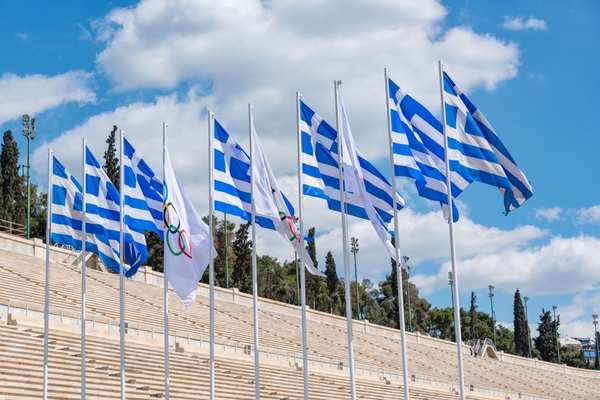
Greece traditionally enters first in recognition of the ancient origins of the Olympic Games. Other delegations generally follow an alphabetical order based on the language selected for that edition, while special protocol positions are used near the end for future host nations and the current host. The host nation enters last.
A country’s position can therefore change from one Games to another because the host language can alter the alphabetical sequence.
The host’s artistic program
The artistic program is the most flexible part of the evening. It can use music, theatre, dance, film, technology and large-scale choreography to tell a story about the host city or country. Some ceremonies present long creative chapters before the parade; others weave them between formal protocol moments.
Recent hosts have shown how adaptable the format can be. Paris 2024 used the city and River Seine as major parts of its setting rather than relying on a conventional stadium-only presentation. Milano Cortina 2026 used a distributed parade across several competition locations. Both approaches demonstrate that Olympic ceremony order is a protocol structure, not a demand that every edition look identical.
Official speeches and the declaration of opening
The president of the organising committee and the IOC president deliver official remarks. The head of state of the host country then formally declares the Games open using the wording established for the Olympic Games or Olympic Winter Games.
For viewers, this is the clearest dividing line between a celebration building toward the Games and the moment the Games are officially opened.
The Olympic flag and anthem
The Olympic flag is brought into the ceremony and raised while the Olympic anthem is performed. This section deliberately shifts attention from the host nation’s identity to the shared identity of the Olympic Movement. Symbolic references to peace can also appear around this stage, depending on the production.
The Olympic oaths
Representatives of the athletes, officials and coaches take Olympic oaths on behalf of their groups. The modern wording emphasises fair play, respect for the rules, inclusion, equality, non-discrimination and sport without doping or cheating.
Olympic flame lighting
For many viewers, Olympic flame lighting is the emotional climax. The flame begins its journey in Greece and travels through a torch relay before reaching the host. During the opening ceremony, the final torchbearer or torchbearers complete the relay by lighting the Olympic cauldron or triggering the host’s chosen cauldron-lighting sequence.
The identity of the final torchbearer is often kept secret because the reveal is part of the drama. Hosts commonly select an Olympic champion, a major national sporting figure or a group whose story reflects the message of that edition.
Why the sequence can seem different on television
Broadcast editing can make the structure feel less obvious because artistic chapters, interviews and other segments may interrupt the formal sequence.
A practical viewing tip is to use four anchor moments: the parade of nations, the official speeches and declaration, the Olympic oath, and the cauldron lighting. Once you identify those, it becomes much easier to understand where you are in the wider ceremony, even when the host uses an unusual venue or format.
It also helps to remember that the opening ceremony is not always the first activity of the Games. Some events can begin earlier for scheduling reasons, so the ceremony marks the official ceremonial opening rather than necessarily the first competition.
Traditions that stay recognisable
The strength of the Olympic opening ceremony comes from repetition with room for reinvention. Greece keeps its symbolic place in the parade. The host receives a final high-profile entrance. The Games are formally declared open. The Olympic flag, anthem, oaths and flame remain key markers. Around them, each host can tell a different story.
The creative layer belongs to the host; the protocol layer connects each edition to previous and future Games.
Useful related topics for deeper context
For more context, readers can explore Olympic symbols and meanings, how the Olympic flame and torch relay work, and Olympic closing ceremony traditions.
Frequently asked questions
Why does Greece enter first in the Olympic opening ceremony?
Greece enters first in the parade of nations to honour the historical connection between the Olympic Games and ancient Greece. Other teams then follow the edition’s approved parade order, with the current host entering last.
Is the opening ceremony order exactly the same at every Olympics?
No. The main protocol elements remain consistent, but hosts can change the staging, venue, artistic sequence and the way sections connect. Major traditions can therefore be preserved even with unconventional formats.
Who lights the Olympic cauldron?
The final torchbearer or group of torchbearers chosen by the host carries out the final lighting sequence. The identity is often kept confidential until the ceremony to preserve the surprise.
What is the purpose of the Olympic oath?
The oath is a formal promise made on behalf of athletes, officials and coaches to respect the rules and the principles of fair play, inclusion and clean sport.
Conclusion
The simplest way to have an Olympic opening ceremony explained is to see it as a ceremonial backbone wrapped in a changing creative production. The parade of nations, official declaration, Olympic symbols, oaths and flame provide continuity; the host’s artistic choices give each edition its own personality. Once those core moments are familiar, even an ambitious ceremony becomes much easier to follow from beginning to end.