
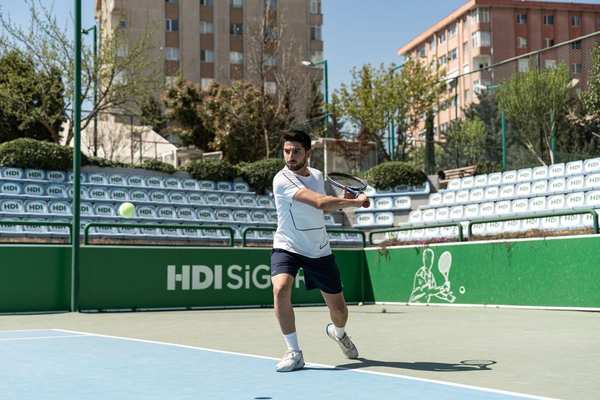
A good slice gives you something topspin alone cannot: time, control, variation, and a ball that stays lower after the bounce. If you are learning how to hit tennis slice, the goal is not to hack underneath the ball or make it spin as much as possible. The better target is clean, stable contact with a controlled racket path that sends the ball forward while adding backspin. Done well, the shot can neutralize pace, change rally rhythm, help you approach the net, and make an opponent hit up from an uncomfortable position.
What a Good Backhand Slice Should Feel Like
A reliable backhand slice feels firm rather than wristy. The racket face is slightly open, the racket head starts above the expected contact point, and the swing moves forward and downward through the ball. You should feel that you are sending the ball toward your target, not chopping straight down at it.
The result is usually a lower, flatter flight than a topspin backhand. After the bounce, the ball may stay low and skid more, although court surface, speed, spin, and landing depth affect the reaction. Control matters more than trying to create extreme spin.
Set Up Early With the Right Grip and Turn
Use a Stable Grip
For a traditional one-handed backhand slice technique, the continental grip is a dependable starting point. It supports a slightly open racket face and helps you keep the wrist firm through contact. The grip should let you control the strings without excessive wrist movement.
Turn Before the Ball Arrives
As soon as you recognize the ball coming to your backhand, rotate your shoulders and take the racket back with both hands. Your non-dominant hand can support the throat of the racket during preparation. This early turn prevents a rushed arm-only swing and gives you time to adjust your feet.
Use small adjustment steps so the ball does not crowd you. You want enough space to contact it comfortably in front of your body rather than beside or behind you.
Build a Controlled Slice Swing Path
Start Above the Ball and Swing Forward
The racket should generally begin above the height of the incoming ball. From there, the slice swing path moves down and forward. Think of the racket traveling on a shallow diagonal rather than dropping vertically. A steep chop often produces a floating ball, while a swing that is too level may not create enough backspin or control.
Keep the Racket Face Slightly Open
An open racket face helps lift the ball over the net while the downward part of the swing creates backspin. The key is slightly. If the face opens too much, the ball tends to float high and short. If it closes too much, the ball may drive into the net.
Keep the wrist quiet through contact. Most of the control should come from your shoulder turn, arm path, racket face, and body position. Flicking the wrist under the ball makes the angle less predictable.
Make Contact in Front
Meet the ball comfortably in front of your body with the arm extended but not locked. Keep your head relatively still and maintain balance through the hitting zone. Imagine the racket moving through the back of the ball and continuing toward your target. That forward component turns a defensive chop into a useful tennis slice shot.
Use the Non-Hitting Arm for Balance
As the hitting arm moves forward, allow the non-hitting arm to move back naturally. This counterbalance helps stop the shoulders from opening too early and makes the stroke more stable, especially when you are slicing on the run.
After contact, do not force an exaggerated finish. Let the racket continue naturally while you recover your balance and prepare for the next shot.
Control Height, Depth, and Direction
A useful slice is not automatically a very low tennis shot. You still need enough net clearance for the situation. From the baseline, aim for dependable depth without floating the ball. On an approach shot, use a more penetrating trajectory that lands deep and stays lower. When stretched on defense, a higher, deeper slice can buy recovery time.
Crosscourt is often the safer direction because you have more court length. A down-the-line slice can work well as an approach or change of direction, but it demands better spacing and a stable racket face.
A Simple Practice Progression
Start near the service line with a partner feeding comfortable backhands. Focus on clean contact, a quiet wrist, and a controlled high-to-low-and-forward path. Once you can send the ball over consistently, move back toward the baseline and add more depth.
Then try a practical rally pattern: hit two or three normal rally balls, play one backhand slice crosscourt, recover, and return to your usual rally shot. This teaches you to use slice as part of point construction instead of treating it as an isolated stroke. Alternate a deep crosscourt slice with a shorter approach slice to learn how swing speed and racket-face angle change trajectory.
Related skills include tennis backhand fundamentals, improving tennis footwork, and how to hit a topspin forehand.
Common Slice Mistakes to Fix
If your slice floats, check whether the racket face is too open or the swing is moving mostly downward with too little forward extension. If the ball goes into the net, make sure you are not closing the racket face or contacting too late. If the shot feels unstable, reduce wrist movement and improve your shoulder turn and spacing.
Another mistake is trying to hit every slice hard. The shot is valuable because it changes pace and shape. A firm, well-placed slice is often more useful than a faster ball that sits up in the middle of the court.
FAQ
What grip should I use for a backhand slice?
A continental grip is the most common starting point because it supports a stable wrist and slightly open racket face. Small personal adjustments are possible, but the racket face should remain easy to control.
Should I swing straight down to create more slice?
No. The racket moves from high to low, but it also needs to travel forward through contact. Swinging straight down often produces a weak, floating ball instead of a penetrating slice.
Where should I contact the ball?
Contact is generally in front of the body, with enough space for the arm to extend comfortably. Late contact makes direction and racket-face control more difficult.
When should I use slice instead of topspin?
Use slice when you want to change pace, keep the ball lower, defend while recovering, handle an awkward backhand, or approach the net with control. It works best as a complementary option rather than a replacement for a dependable topspin rally ball.
Build a Slice You Can Trust
Make the technique simple and repeatable: prepare early, create space with your feet, start the racket above the ball, keep the face slightly open, and swing forward as well as downward. Once those pieces are consistent, experiment with height, depth, pace, and direction. A dependable backhand slice gives you another way to solve problems during a point when a topspin swing is rushed, awkward, or simply not the best tactical choice.