
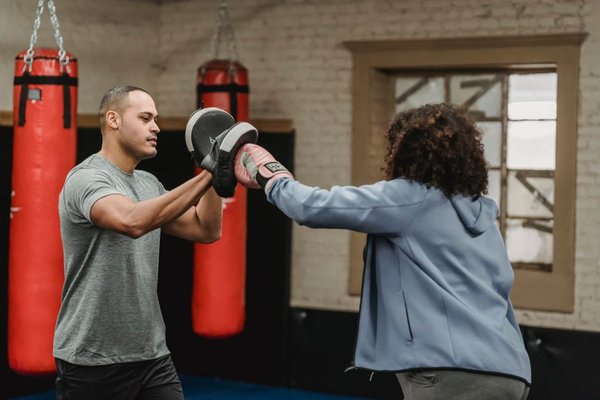
Good boxing defense is not about making every punch miss by inches. It is about staying protected without losing balance, sight of your opponent, or the ability to move next. Beginners often spend hours learning combinations, then discover that an ordinary jab is difficult to handle when it comes back at them.
The most useful boxing defense techniques work together. Your guard protects you, your hands intercept shots, your head moves off the centerline, and your feet take you out of danger. The real skill is choosing a suitable response without overreacting.
Start With a Defensive Position You Can Trust
Stand with your feet comfortably apart, knees slightly bent, chin tucked, and eyes forward. Keep your rear glove near your cheek, lead hand ready, and elbows close enough to protect your ribs. Stay relaxed enough to move. A tight, rigid guard can slow your reactions.
After punching or defending, return to a position where you can see, step, and protect yourself again. Your stance is the foundation for every technique that follows.
The Essential Boxing Defense Techniques
High Guard and Covering Up
A high guard is the beginner’s dependable first layer of protection. For head shots, bring your gloves close to your face and use your forearms to shield the sides of your head. For body shots, keep your elbows near your torso rather than lowering both gloves.
Of the basic boxing blocking techniques, covering is useful when a shot arrives unexpectedly or several punches come together. But do not hide behind your gloves indefinitely. Keep watching your opponent and move toward a safer angle when possible.
Catching a Straight Punch
A catch receives a straight punch on your glove rather than chasing it. In an orthodox stance, you can receive a controlled jab with the rear glove near your cheek. Keep your wrist aligned and use a small movement.
Reaching forward too far can expose you to the next shot. Practice catching slow jabs with a coach before adding speed or follow-up punches.
Using a Boxing Parry
A boxing parry redirects a punch instead of absorbing it directly. Use a compact touch of your glove to move an incoming straight punch off its line. The movement should be economical, not a sweeping slap that leaves your face exposed.
Parries can work well against a predictable jab, but guessing early is risky. Sometimes a straightforward catch or guard is the better choice, especially against an unfamiliar partner.
Slipping Straight Punches
To learn how to slip punches, move your head just outside the path of a straight shot. Bend your knees a little and rotate through your torso, keeping your eyes on the person in front of you. You need only a modest shift, not a dramatic dive.
Good boxing head movement is small and balanced. Overdoing a slip can put you in the path of a follow-up punch. Begin with slow, single jabs and reset your stance after every repetition.
Rolling Under Hooks
A roll, or bob-and-weave movement, is useful against a wider hook. Bend at the knees, pass beneath the imagined punch, and rise on the opposite side while maintaining your guard. Picture a shallow U-shaped route.
Avoid folding at the waist and staring at the floor. You need to see what comes next, particularly because a partner may follow a hook with another punch. Learn rolling slowly before combining it with counters.
Defending With Footwork and Pivots
Sometimes the simplest defense is making a punch fall short. A small step back changes range; a side step or pivot changes the angle. Move without crossing your feet or narrowing your stance so much that you lose balance.
Footwork becomes especially valuable after blocking or rolling. Rather than waiting in place for another shot, take a controlled exit and reset. It also helps connect your defense to basic boxing punching combinations.
How to Match the Defense to the Punch
Imagine a partner throws a light jab followed by a lead hook. You catch the jab with your rear glove, keep your other hand protecting your face, then roll beneath the hook and step to the side. The point is not a flashy sequence. It is to finish protected, balanced, and in a better position.
Catches, parries, and slips often suit straight punches. Rolls are usually practiced against hooks. Guards provide a fallback when timing is uncertain, while footwork helps you avoid exchanges or exit them. No choice is foolproof: speed, combinations, and changing angles all affect the result.
Simple Drills for Better Defensive Habits
Begin with a two-minute mirror round. Move between your stance, high guard, short slips, and small pivots. Check that your feet stay apart, chin remains protected, and eyes stay level. Prioritize accuracy over speed.
Then ask a qualified coach or partner to present one clearly signaled jab at low speed. Catch it for several repetitions, then alternate between catching and slipping. Once you are comfortable, introduce a predictable jab-hook sequence and select the agreed defenses.
A slip line can help you rehearse compact head movement. Bend your knees rather than collapsing at the waist. Contact drills should be supervised, with appropriate protective equipment and controlled intensity. Defensive training can reduce exposure to punches, but it cannot eliminate boxing’s risk of injury.
Mistakes That Undermine Good Defense
Closing your eyes hides important information. Leaning straight backward without moving your feet may leave you unbalanced. Dropping both hands after a successful slip creates a new opening. Repeatedly making giant movements can be just as troublesome as standing still.
After a light technical round, ask yourself three questions: Could I see the next punch? Was I balanced afterward? Could I take another step? These checks are more useful than judging a drill only by the number of punches avoided.
Frequently Asked Questions
Which boxing defense should beginners learn first?
Start with a stable stance, high guard, and basic distance control. Catching a slow jab is a sensible next step because it teaches you to recognize a punch without reaching or panicking.
Is slipping better than blocking?
Not always. Slipping can create a useful angle, but it demands timing and balance. Blocking is often more reliable when the punch arrives unexpectedly. Both belong in a complete defensive toolkit.
Can I practice boxing defense alone?
Yes. Shadowboxing, stance resets, pivots, and controlled slip-line drills build coordination. Coach-led partner practice remains important for learning timing and distance against actual punches.
How can I stop flinching at incoming punches?
Practice slow, predictable, noncompetitive partner drills with one agreed punch and defense. Progress gradually under a coach’s supervision rather than trying to force confidence through harder contact.
Put Defense Into Every Training Session
Effective defense comes from small, repeatable habits: protect your chin, intercept straight punches, move your head without overreaching, roll without losing sight, and step away when needed. Work on one skill at a time, then connect it to your footwork and punching. The aim is not to look untouchable; it is to stay composed and ready for the next decision.