
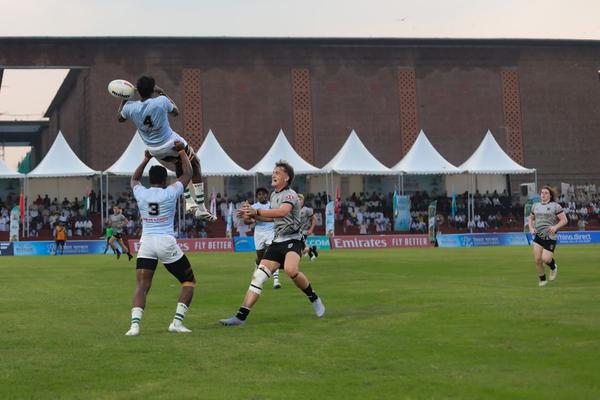
At first glance, rugby sevens and fifteens look like the same sport played at different speeds. Both feature tackles, backward passes, tries and fierce competition for possession. Yet reducing a side from 15 players to seven changes far more than the team sheet. It transforms how much space each defender must cover, how attacks develop and how quickly a single mistake can become a try. This rugby sevens vs fifteens comparison explains the differences that matter most when watching, playing or learning either format.
Rugby Sevens vs Fifteens at a Glance
Rugby sevens fields seven players per team; traditional rugby union has 15. Both normally use a full-size rugby pitch, but their match clocks are very different. A standard sevens match consists of two seven-minute halves, while a standard senior fifteens match has two 40-minute halves.
Sevens usually has a half-time break of no more than two minutes, compared with up to 15 minutes in fifteens. World Rugby also permits a sevens competition final to last up to 20 minutes of regulation time, although seven-minute halves are the familiar format. These timings exclude applicable time lost or extra-time.
Same Pitch, Very Different Amounts of Space
Sevens does not ordinarily shrink the playing field to match its smaller teams. Seven defenders must protect roughly the same width that 15 cover in fifteens, leaving much larger gaps between players. An attacker who wins the outside shoulder of a defender may find an uninterrupted route towards the try line.
In fifteens rugby, defensive lines tend to be denser. A line break is still valuable, but cover defenders are often closer. Teams can build pressure through repeated carries and phases rather than expecting every break to turn into an immediate score.
Match Length Changes Every Decision
Fourteen minutes sounds brief until you watch seven players sprint, tackle, recover and sprint again. With so little time available, a knock-on, missed tackle or poorly judged kick can become decisive. A team trailing by two tries cannot count on a long period to work its way back.
Fifteens offers more room for tactical adjustments. Coaches can alter territory, kicking strategy and attacking patterns as conditions change over 80 minutes. Managing fatigue and controlling the final quarter are major parts of the contest.
Scoring and Restarts: Similar Points, Different Rhythm
The basic scoring values are shared across the rugby formats: a try earns five points, a conversion adds two, and a penalty goal or drop goal earns three. The methods and restarts are not identical, however.
In sevens, conversions must be attempted as drop kicks, generally within 30 seconds of a try. Fifteens conversions may be place-kicked or drop-kicked and have a longer time allowance. Sevens also requires penalty-goal attempts to be drop kicks.
Perhaps the most surprising sevens difference comes after a score. The team that scored takes the restart kick. In fifteens, the team that conceded the points restarts. That allows a successful sevens side to compete immediately to regain possession and potentially score again before its opponent settles.
Scrums, Lineouts and Substitutions
Scrums show how differently the two versions distribute their players. Fifteens uses eight forwards in a full scrum, with distinct front-row, second-row and back-row responsibilities. Sevens uses only three players per side. The smaller scrum still contests possession, but it occupies far fewer players and usually leads more quickly back into open play.
Both formats retain lineouts when the ball goes into touch. In fifteens, larger forward groups can create elaborate throwing and lifting options. In sevens, fewer available players mean simpler structures and an immediate need to reorganise the defensive line.
Substitution rules differ too. Under World Rugby’s standard sevens variations, a team may nominate and use up to five replacements. International fifteens commonly permits eight replacements, with specialist front-row cover requirements.
Why the Tactics Look So Different
Fifteens can reward territorial kicking, mauls, sustained forward carries and patient phase play. Its positions encourage specialisation: props anchor scrums, locks contest lineouts, and backs organise attacking space. A team may deliberately spend several minutes forcing penalties and wearing down a defensive pack.
Sevens places a premium on possession, support running, one-on-one tackling and making the right choice in open space. Players often delay a pass to fix a defender before releasing a teammate into a gap. Kicking away possession can be especially costly because there are so few defenders available to chase and recover.
What Changes for Player Fitness?
Sevens places heavy demands on repeated acceleration, high-speed running and rapid recovery after long defensive chases. Every player must contribute to tackles, support lines and ball movement across large areas. A small lapse in positioning can leave a teammate defending an enormous gap.
Fifteens involves a longer overall workload and, depending on position, more repeated close-contact efforts at scrums, rucks and mauls. Front-row forwards and outside backs have notably different physical jobs. In sevens, roles remain distinct, but versatility and the ability to cover space become harder to avoid.
A Simple Example to Watch for During a Match
Imagine an attacker receiving the ball 20 metres from the touchline with two teammates outside. In sevens, defenders may be spread thinly across the entire field. One convincing step inward can draw a tackler and open a direct passing lane to the edge.
In fifteens, additional defenders may slide across to close that lane, encouraging the attack to recycle the ball and try another phase. Next time you watch the two formats, focus on the defenders outside the ball rather than the ball-carrier alone. Their spacing explains much of the difference in attacking style.
For related reading, a guide to rugby union positions, an explanation of rugby scoring rules and a beginner’s overview of rugby sevens tactics can help connect these observations.
Frequently Asked Questions
Is rugby sevens played on a smaller pitch?
No. Competitive sevens generally uses a standard rugby union field, despite having fewer than half as many players on each side. That extra space per player is central to its fast, open style.
Is rugby sevens more physically demanding than fifteens?
Neither format is automatically harder in every respect. Sevens typically requires more repeated high-speed efforts relative to its short playing time, while fifteens tests endurance over a much longer match and can involve greater sustained contact demands.
Can a fifteens player switch to sevens?
Yes, but success is not guaranteed. Skills such as tackling, passing and reading space transfer well, while sevens demands additional conditioning, wider defensive coverage and fast decisions with limited support.
Are the rules completely different?
No. Both are forms of rugby union governed by the same core laws, with specific sevens variations covering match duration, team numbers, restarts, some kicking procedures and set pieces.
Which Format Should You Watch or Play?
Choose sevens if you enjoy open-field running, rapid momentum swings and matches where every possession carries immediate weight. Choose fifteens if you prefer detailed positional battles, territorial strategy and pressure built over time. Watching both reveals something useful: rugby’s essential skills stay recognisable, but changing the numbers changes the entire shape of the game.