
A swimmer can look smooth through the middle of a length and still lose a close race at the wall. The start creates the first burst of speed, while every turn offers another push from a solid surface. The challenge is keeping that speed instead of wasting it through a splashy entry, loose streamline, rushed rotation, or mistimed breakout. Effective swim starts and turns are less about dramatic movements than about connecting several small actions without hesitation.
Build a Start That Carries Speed into the Water
For freestyle, butterfly, and breaststroke events, swimmers typically start from the block. Many use a track-style stance with one foot near the front edge and the other against an adjustable rear wedge. The best foot placement is not identical for everyone: you need a stable position that lets both legs drive while your hands release cleanly.
Set your feet before the starting command, keep your weight controlled, and avoid rocking or guessing when the signal will sound. On the signal, push forcefully through the legs as the arms move toward a tight overhead line. Think about traveling forward with control rather than simply jumping high. A powerful block exit means little if the body folds or hits the water with excessive drag.
Enter Through a Narrow Opening
Hands should lead the entry, followed by the head, torso, hips, and legs along a similar path. Keep the head aligned between the arms and the core firm. Entering too steeply can send you unnecessarily deep; entering too flat may create a hard splash and interrupt momentum. The ideal angle depends on the swimmer and pool, so review side-view video with a qualified coach rather than copying an elite athlete’s dive blindly.
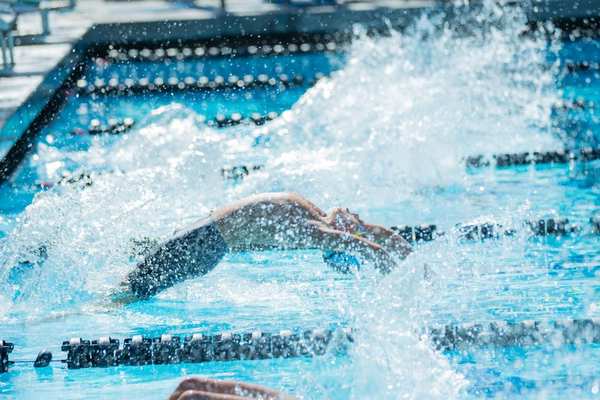
For backstroke, swimming starts begin in the water. Swimmers hold the grips, place their feet against the wall, and drive backward and upward into an arched flight before entering in a streamlined position. A backstroke starting ledge, where permitted, may improve foot security, but it does not replace controlled technique.
Streamline First, Then Choose Your Breakout
Immediately after entry or a wall push, squeeze the upper arms beside the ears, overlap the hands, and keep the body long. A relaxed head, bent knees, or separated arms exposes more surface area to the water. Good streamlining protects the speed gained from the block or wall.
Underwater dolphin kicks can help freestyle, butterfly, and backstroke swimmers maintain momentum, but more kicks are not automatically better. As speed decreases, the swimmer must decide when surface strokes will become more effective. The fastest swim breakouts feel like a continuation of the underwater movement, not an abrupt stop followed by a restart.
Under World Aquatics-style racing rules, the head must break the surface by 15 metres after starts and turns in freestyle, backstroke, and butterfly. Breaststroke follows its own underwater pullout rules, rather than the same extended dolphin-kick pattern. Practise legal, efficient distances instead of treating 15 metres as a target everyone must reach.
Make the First Stroke Count
Start the first surface stroke while your body is still moving forward strongly. Avoid lifting the head to look for the lane markers, and resist the urge to breathe immediately if doing so disrupts alignment. Your first few strokes should carry underwater speed into a sustainable rhythm. For more detail on that rhythm, a focused guide to freestyle stroke technique makes a useful companion.
Approach Flip Turns Without Losing Rhythm
Strong flip turns begin several strokes before the wall. In freestyle, watch the approaching markings without lifting the head, keep the final stroke purposeful, and initiate the somersault close enough that your feet can plant comfortably. Gliding into the wall too early usually sacrifices speed; arriving cramped makes the rotation messy.
Tuck the chin, drive the head and upper body into the rotation, and let the legs travel over. Plant the feet roughly hip-width apart with knees bent enough to generate a firm push. Extend into streamline as you leave the wall. You can rotate toward your stomach during the push-off and glide rather than twisting your whole body before the feet have finished driving.
Know How Each Stroke Changes the Turn
Freestyle generally allows a somersault turn, provided some part of the swimmer touches the wall. Backstroke has specific rotation requirements: the swimmer may roll toward the breast to initiate the turn, use the permitted continuous arm action, and must leave the wall on the back. Counting strokes from the backstroke flags can help with the approach, but the count should be rehearsed at different speeds.
Breaststroke and butterfly require a simultaneous, separated two-hand touch at the wall. Rather than trying to perform a freestyle-style flip turn, swimmers draw the knees underneath, pivot, set the feet, and push away in a streamlined position. In breaststroke, the underwater pullout has a distinct sequence, including a permitted single butterfly kick under the applicable rules. Learn that sequence with a coach before racing.
Measure the Transition, Not Just the Wall Contact
A simple practice test can expose where time disappears. Ask a coach to time three race-pace turns from five metres before the wall to five metres after it. Record the average, then film from the side if possible. Compare your final approach strokes, foot placement, time underwater, and breakout location. Change one feature at a time before repeating the test.
For example, if your feet land too low and you surface almost immediately, work on a more consistent plant and a tighter push-off before adding underwater kicks. If you stay underwater but slow noticeably before surfacing, try an earlier breakout. The goal is the fastest complete transition, not the prettiest isolated flip. Underwater dolphin kick drills and race-pace training sessions can support that work.
Always practise racing starts with qualified supervision, in a pool approved for the activity and with a clear landing area. Beginners should learn safe progressions before attempting block dives. Never extend underwater work to the point of breath-holding distress, and avoid prolonged or repeated underwater breath-holding drills.
Frequently Asked Questions
What is the biggest mistake in swim starts and turns?
Breaking alignment too early is a common problem. A loose entry or push-off creates drag just when the swimmer should be carrying the most speed. Poor approach timing and rushed breakouts can add further losses.
How far should a swimmer stay underwater after a turn?
There is no ideal distance for everyone. Freestyle, backstroke, and butterfly have a 15-metre limit, but the best breakout often comes earlier. Choose the point where underwater speed begins to give way to a stronger surface stroke.
Are flip turns faster than open turns?
For most trained freestyle racers, a well-executed flip turn is usually faster than an open turn. Breaststroke and butterfly require two-hand touches, so their racing turns use a different technique.
Make Every Transition Part of the Race
The most useful improvement is often a cleaner connection: block to entry, entry to streamline, approach to rotation, and push-off to first stroke. Test those links at realistic speed, keep the movements legal and safe, and track what actually makes you faster. When transitions become reliable, every length gives you another opportunity to protect hard-earned momentum.